“Control” is a strong word when talking about a weed in the sub-tropic Gulf South. Is there really any such thing as controlling the weeds, especially if you’re all organic? I mean, really? It’s more of a constant battle with a moving line of scrimmage.
Between the part-time help and elbow grease of the WWOOFers, we spend hours each week pulling weeds. The pulled greenery is either mulched back into the field or fed to the chickens.
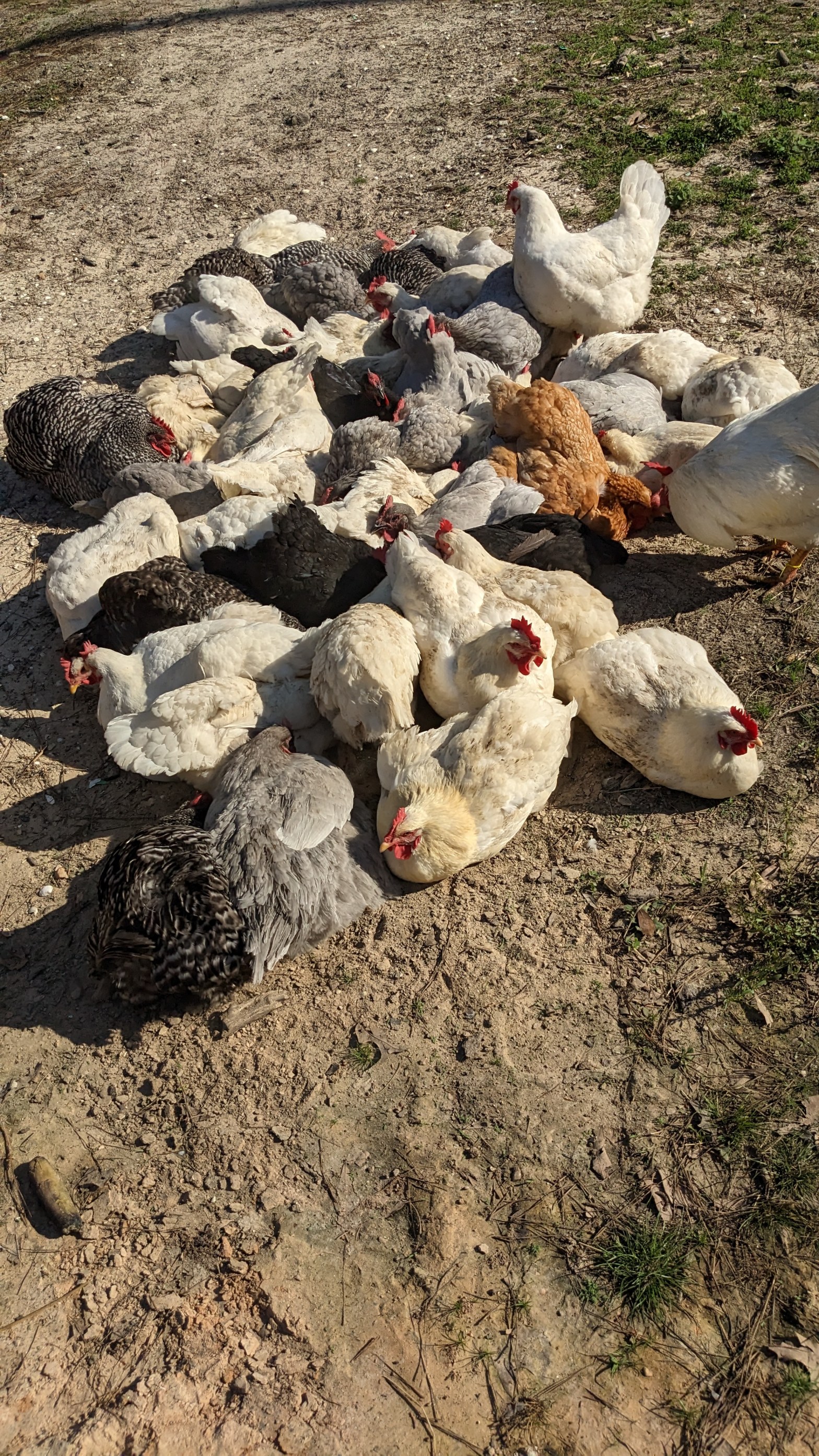
This works out great for feeding the hens. They used to forage freely but then the coyotes found them. Coyotes will take a hen in mid-day with you and your useless dog clearly visible. The hens still forage occasionally but on a random schedule and only when watched closely.
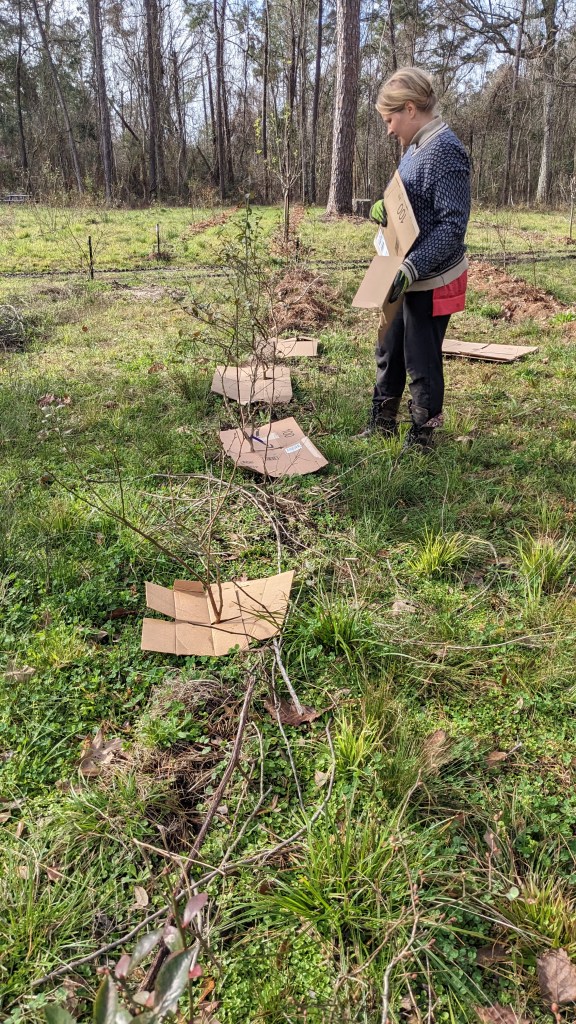
Cardboard being placed around blueberries to organically keep the weeds down.
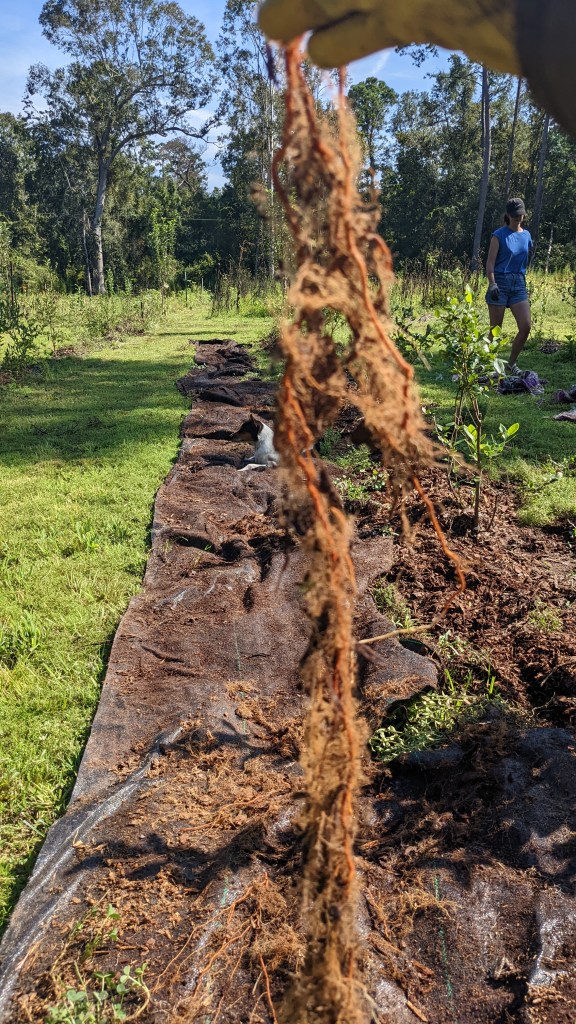
We’ve tried a myriad of ways to control weeds in the berry field: mulch cloth, pine bark, pine needles, leaves, and lawn clippings. Some methods work, and some don’t. Mulch cloth was the worst–an expensive exercise in how to grow lots of choking weeds that could not be pulled up. Our method right now is a combo of hand pulling, a layer of cardboard on the ground, and leaf or pine bark litter mulched on top.
Weed cloth was a waste of time and money, harboring weeds, fire ants, and damaging the roots–seen here–of the berry bushes.
Weeding and mulching are a year around, endless task, in both the berry field and the kitchen garden. The pulled weeds supplement the chickens. And for now, with the use of a lot of cardboard that is otherwise waste, we’ve made great headway in weed control in a way that is safe for the environment.
How do the other gardeners out there control their weeds? Leave a comment with your methods and ideas to let us know.
I’ve gardened for many years and this obvious point escaped me: many garden plants are perennials in warmer, non-frost zones. Indeterminate tomatoes, peppers, eggplant, and okra are some of the varieties that will continue to grow if not killed back by frost.
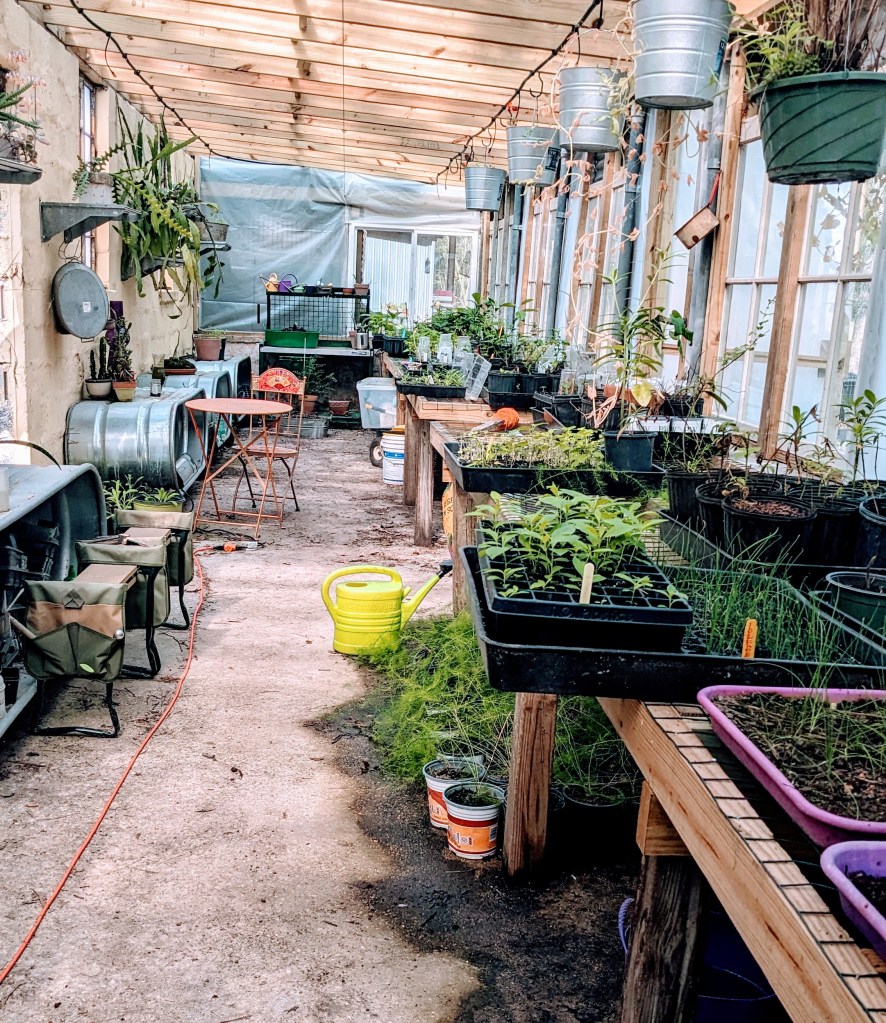
The apiary greenhouse.
I got a link to a story about overwintering veggies and found a good amount of information (too much, maybe) on the subject. Some people overwintered their plants in a basement or a garage. I have a small greenhouse so I decided to test the theory. I selected a few of the best-performing peppers and favorite tomatoes and trimmed them back to a few branches. I did this late in the year last fall before a frost hit. They looked dead, like skeletons of their summer selves, but I put them in one-gallon planters and moved them to a cool spot in the seed starting room.
This is how the peppers looked all winter.
An overwintered pepper flowers the first day in the garden.
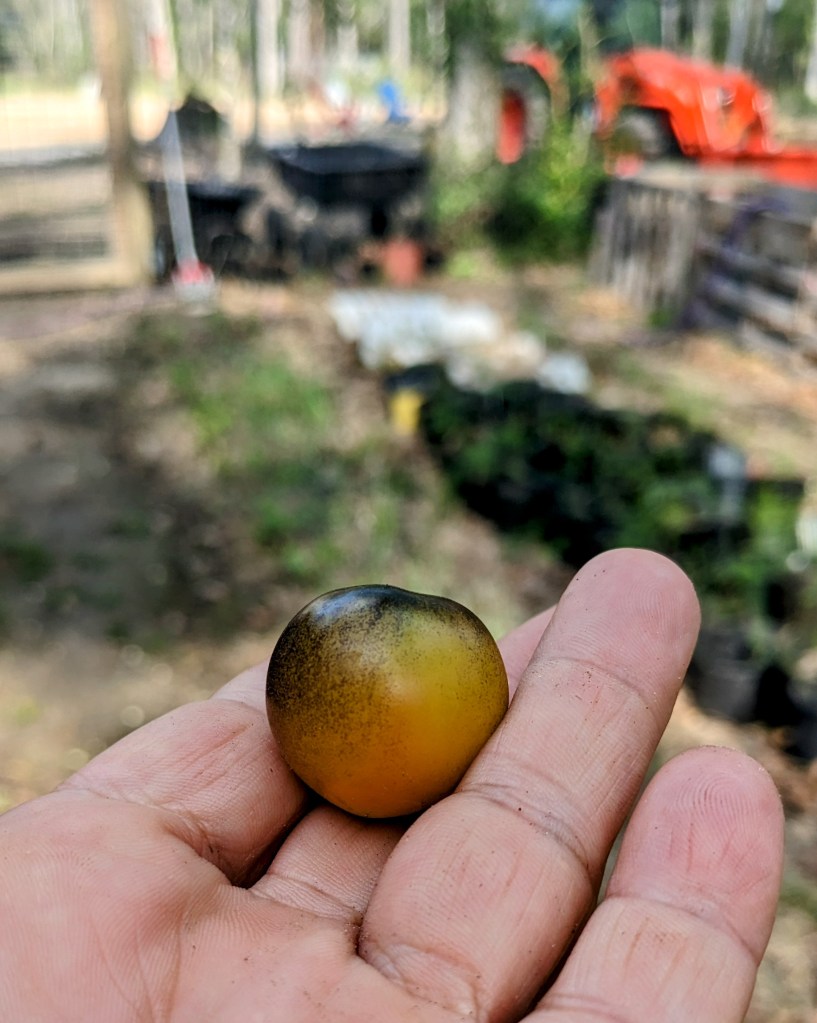
The idea is for them to go into a semi-dormant state until you put them out in the spring. At first, everyone looked great. Growth did slow but did not stop. One tomato even produced fruit, a lovely cherry tomato that stubbornly clung to the vine for months, refusing to ripen. The three days of sub-freezing weather around the holidays was too much for most tomatoes. I had set them too close to a door with a draft and all but two eventually withered. The peppers, though, all made it through the freeze and when the days started to get longer they began to flower.
The Natural world is in a life-or-death race to produce the next generation. There is no procrastination in nature, just a frenzied seizing of every opportunity to grow and reproduce. The gardener must try to keep pace. And try I did. This week I and the peppers, the tomatoes, several flats of cruciferous starts, and a litany of flower bulbs and seeds joined the mad rush. And thanks to the perennial spirit in the pepper shrub I have plants already trying to set fruit. Not bad for the first week of March, but I am still behind in the race.
And the tomato? The day the vine got set out the fruit proceeded to ripen–the first tomato of the season.
The first tomatoes, a purple-shouldered cherry variety that packs a punch of flavor.
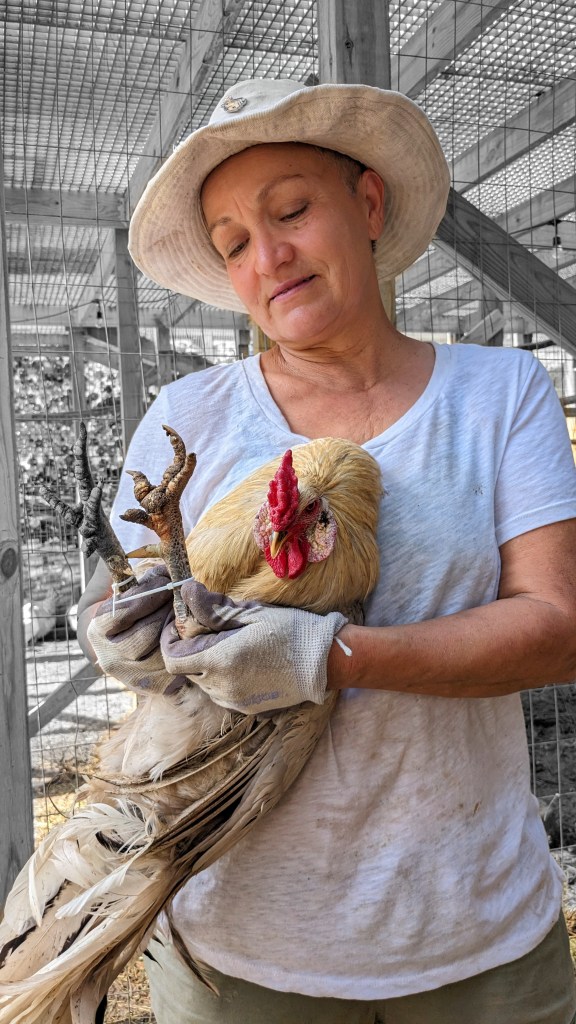
We have about 70 laying hens at the apiary. This past week we marked all the younger birds, those born in 2022, with leg bands so you can tell at a glance how old they are.
There’s an international coding system for marking queen bees that keeps track of their age and makes them easier to spot during hive inspections. Our chickens are marked using the same color system as the honeybees to keep things simple.
There are a good number of commercially available marking bands on the market. At Big Branch Apiary we use small zip ties. We apply them once the birds are fully grown so the legs don’t outgrow the bands, and we check them periodically to make sure they’re not irritating the leg. You can cut the excess off but if you leave it attached you can see them easier and it doesn’t seem to bother the birds.
Things have been busy as we race with Nature to get gardens planted, berries fertilized, and the farm ready for the u-pick season. Our chore list looks something like this: 1. Feed bees. Lots of food will be left out for the bees so they have something to preoccupy them tomorrow when we dig into the hives to look for signs they are ready to split. We will look for queen cells and drones and hopefully, if we find what we are looking for, split some hives before they swarm and split on their own. 2. We’ve been working on the kitchenette in the barn for what seems forever. Today we’ll paint a wall and maybe hang the cabinets. 3. We have a new WWOOFer arrive, Emma from Wisconsin. Sadly we’ll bid farewell to our Finnish WWOOFer, Maria, this week. I can’t say enough good about the help we get from these folks. 4. And we round that out with the usual: weeding, feeding hens, and collecting eggs to fill the week’s orders.
I recently made a post o the farm’s Facebook page about some apple trees we plant as part of our USDA Conservation Stewardship Program. One of the comments was about how nice it would be if we could do fall apple picking, “like they do up north.”
Well, folks, it may be that we can all grow apples, even here in the humid, muggy, warm Gulf South.
In order to set fruit many plants need a certain number of chill hours, this is the number of hours a plant requires the temperature to dip below 45℉. Olives, blueberries, pears, apples, and other fruit producers require a certain number of chill hours to trigger a bloom and subsequent setting of fruit. If you want to grow fruit you need to make sure you plant a cultivar to match the chill hours in your USDA zone.
I had no idea that apples had cultivars that would grow in our USDA zone until a friend of mine mentioned his apples. My gardening mind was blown so when we entered into our CSP agreement with the USDA I decided to try apples.
Like so many fruit trees, apples do not breed true from seed. Some other common fruits that this is true for are avocadoes, citrus, and pears. You can plant a seed from your favorite fruit but there’s no guarantee that what grows will even be edible. For this reason, most trees are almost always grafted.
So before you buy your tree decide what size you want: full, semi-dwarf, dwarf, miniature, etc., and chose the rootstock accordingly.
There are a lot of nurseries selling apple trees. After extensive searching, I opted to get the following varieties from Mehrabyan Nursery: Newton, King David, Rubinette, Pink Lady, and a Whickson Crab (plus 5 Persimmons), I ordered the Fuji and Ein Shemer from Willis Orchard. If hey do well we will likely buy more and plant a small orchard.
We already have pears and have a schedule of spraying (neem oil and copper sulphate0 for pests and diseases that is similar to the requirements for apples.
one more thing to note if you would like an apple tree–Like rabbiteye blueberries, they require cross-pollination to produce fruit. One tree may be lovely but two, that is going to get you something to stuff your apple pie with!
Hope you found this interesting. For more of the same garden mendacity, consider subscribing.
If you have a bird feeder you know what I mean when I say it is more entertaining than a TV. And that as a hobby it can easily creep into an expensive obsession. Though small, your ever-hungry avian visitors consume large amounts of food–we now buy it in 40 pound bags. Then there are the feeders. It’s easy to spend $100, $200, or more on something that has better amenities than your house, but one of the main things that will lead the backyard enthusiast to overspend on a feeder is how well it keeps out squirrels.
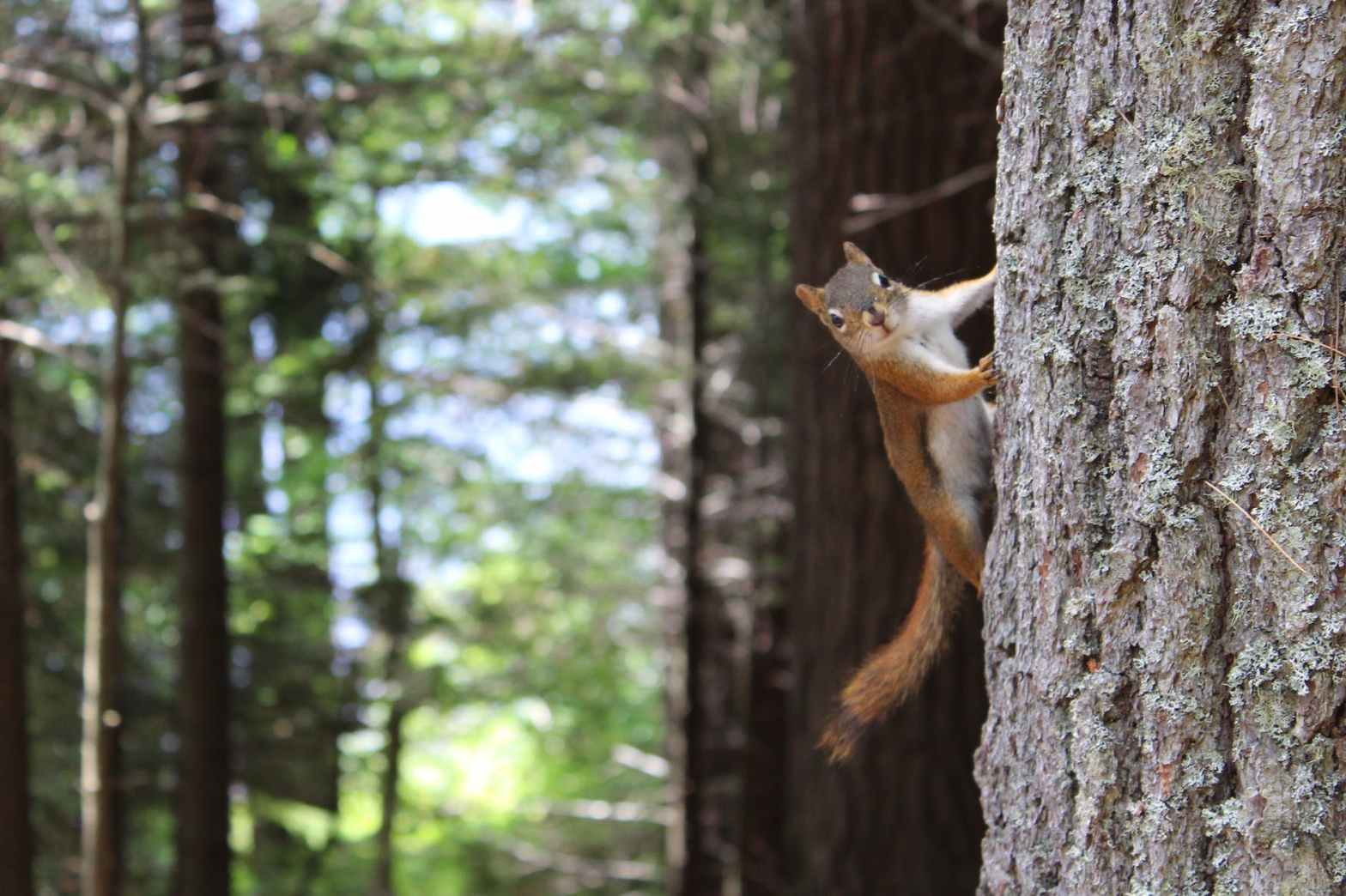
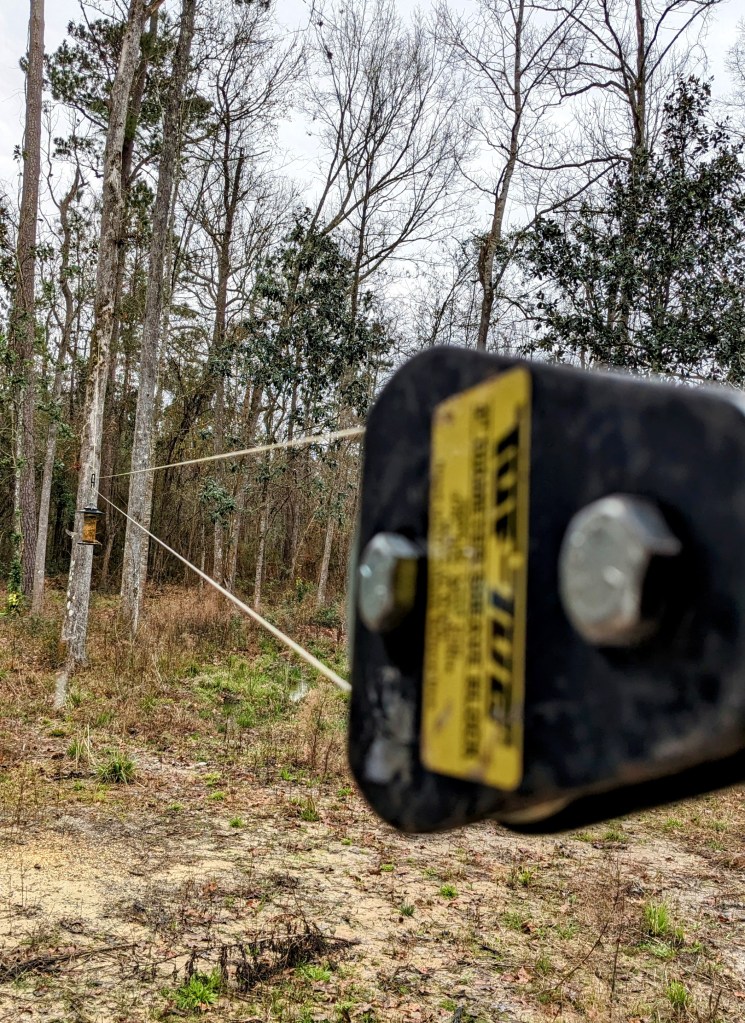
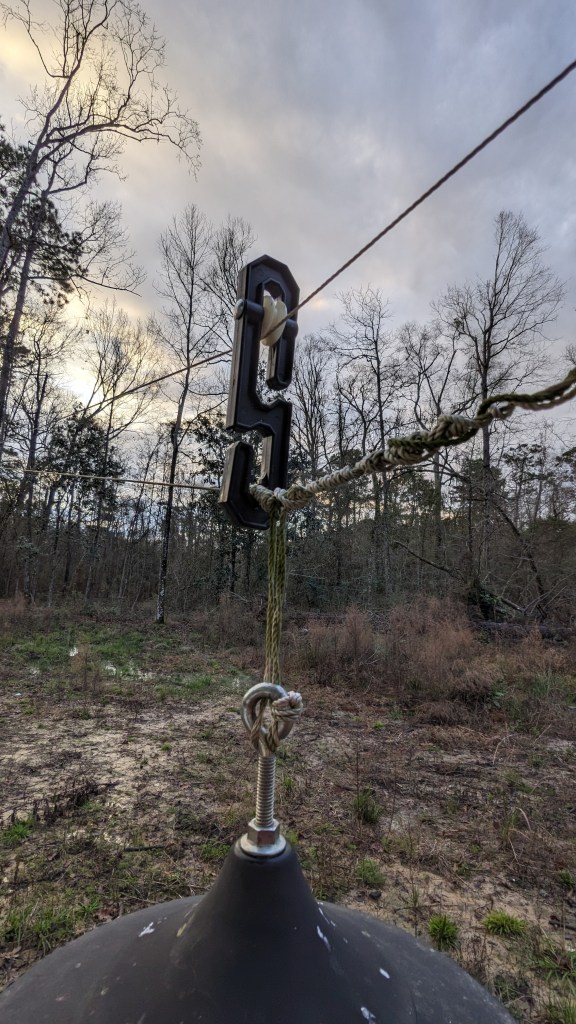
I like squirrels. They’re playful, surprisingly intelligent, and will haul off several years’ worth of food in a flash in those cute little cheeks. The Holy Grail of feeders is one that is squirrel-proof. So, when we set up a wild bird feeder the squirrels descended with glee, figuring out how to thwart each new attempt to keep them out. It was fun to watch them try to find ways to get at the feed. They would sit on stumps and branches near it, or on the ground beneath it and chatter as they took turns trying out their plan to get at the food. Eventually, we managed to outsmart them by suspending the feeder off the ground higher than they could jump, away from limbs they could drop from, and out on a wire farther than they could hand-over-hand out to. And the wire had to be small enough that they couldn’t walk out on it–that one is very important as you know if you’ve ever seen them run along power lines.
This is a squirrel’s eye view of our feeder. There’s a squirrel-deterring climb from the pulleys to the bird feeder shown in the center-left.
Squirrels still visit the feeder. In the summer, when the wildflowers give more cover, squirrels, rats, and voles compete with the chickens and peacocks for the seed that falls to the ground. But in the winter the bare ground makes them an easy target for hawks that occasionally drop in, quite dramatically, for lunch.
This hook, a clothesline spreader, is critical to the function of the feeder. It keeps the bottom cable from sagging within squirrel range when the feeder is full.
Everything that appears at the feeder adds to the entertainment and the type of wild birds are a kaleidoscope of varieties and colors that change with the seasons.
Goldfinch arrived this month in their subdued winter plumage. These little guys empty the feeder faster than anything except squirrels. These are on the ground under the feeder.Goldfinches toss seeds to their buddies on the ground. This week we’ve also seen chickadees, tits, cardinals, and a bluebird at the feeder.
For now, the feeder is squirrel-proof but I’ve been laughed at for saying that. Somewhere there’s a nest of them gathered around a stolen drone, chattering and rubbing their little hands together as they figure out how to use it to get at the seed in the feeder.
It’s been tees & shorts weather for a week, but two light freezes have reminded us to keep the insulated coveralls at the ready. And we are, ready that is. Pipes are insulated, plants are mulched, and heaters are going in the barn for the chicks and in the greenhouse for the seedlings.
My go-to: 50-cell deep seed starting flats.
Yesterday, the remaining veggies got down for setting out in March: eggplant, tomatoes, peppers, and multiple brassicas. A new one was added: cape gooseberry, a tasty fruit tasting like a mix of kiwi and tomatoes. There’s magic in every seed.
That includes the flower seeds. While zinnia and sunflowers don’t like their roots disturbed (read: don’t transplant well), many flowers do. We’ve got plenty of flowers to move out when the frost danger is past.
A recommendation on seed starting pots if you fight your inner procrastinator: deep cell. I use 50-cell flats that are 5″ deep. I buy mine by the case at Greenhouse Megastore but you can sometimes buy smaller amounts at Johnny’s but they often sell out. Of course, an online search will likely produce a harvest of sources.
Red maple buds–one of the first honeybee food sources to appear in the spring.
Our mid-winter chore list for the day looks like this: 1. Feed & care for the flock. Hens are laying well, and some chicks have started to recover from the fowl pox but sadly, two succumbed this past week. 2. Feed the bees. They’re still voraciously downing food: sugar water and pollen. But there’s hope for wild forage soon: we saw red maple blooming during a hike into the swamp. Red maple is a southern bee’s jump-start food. 3. Weed, mulch, gather eggs, and a little straightening up will round out the day’s to-do.
Big Tom led the way on a recent hike into the swamp where we saw Acer rubrum, red maple, starting to bloom.
“Don’t think the garden loses its ecstasy in winter. It’s quiet, but the roots are down there riotous.” ~RUMI
It got up to a balmy 72℉ today. On Friday the low is forecast to be 33℉. That is our Gulf Coast winter–schizophrenic–but mild enough still that we are able to grow vegetables year-round.
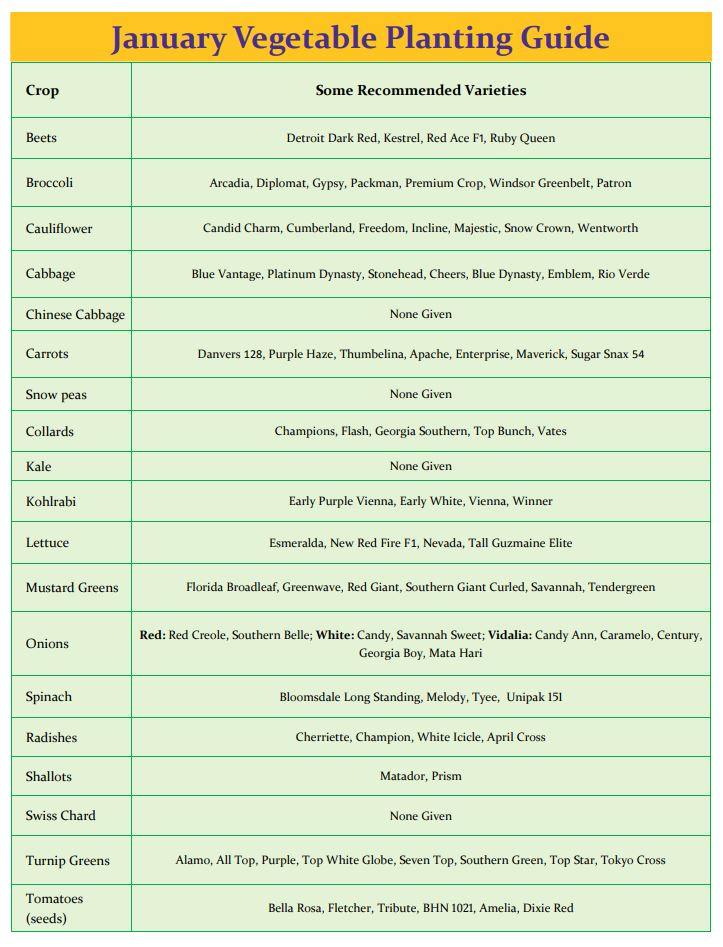
A lot of you already take advantage of some sort of “what to plant” calendar. My favorite is the one in the LSU calendar but you can sign up to get it as part of the GNO Gardening Magazine. It will tell you what to plant by month, often with the specific variety known to do well in our area. Many companies selling seeds have something similar on their websites, or in their seed catalogs. Two of my favorites are Johnny’s and Baker Creek. Johnny’s caters to the market grower and has an extensive grower’s library full of garden how-to. Baker Creek ships their seed for free and offers an impressive selection of the hard-to-find. They are a foodie’s dream supplier. They have free and paid versions of their seed catalog–both versions are full of wisdom, how-tos, and even recipes.
This is an excerpt from the GNO Gardening Newsletter showing what to plant in January. The magazine offers information on recommended plants, common diseases, insect pests, weed pests, and more. If you live in the greater New Orleans area or USDA Zones 9a & 9b then you may be interested in signing up for this monthly magazine. If so you can email GNOGardening@agcenter.lsu.ed and ask to be signed up.
But what we planted at the apiary today was nearly 200 blueberry bushes. Some were replacements for bushes that died but most were new varieties we’re trying to see if well they do in our field. We put in rows of Prince and Alapaho rabbiteye bushes and replanted some Sweetheart that had died for some reason probably linked to farmer ignorance.
Our to-do list was short today: 1. Feed birds. 2. Collect eggs. 3. Feed bees if needed (it wasn’t) 4. Plant 200 blueberry bushes.
It was a satisfying day with accomplishment and a big project marked off the list.
“A true conservationist is a man who knows that the world is not given by his fathers, but borrowed from his children.”
~John James Audubon.
Today we are planting trees at the apiary. And if you farm or dream of farming, or know someone who does, you will want to pay attention to this story because there is a great but underutilized program available to incentivize farmers to care for the land.
Big Branch Apiary has a Conservation Stewardship Program agreement with the Natural Resources Conservation Service. The NRCS is part of the Department of Agriculture and comes under the USDA. A CSP agreement is more nuanced than “plant trees, get paid.” An agent works with you to determine what will benefit your land’s natural environment. You will jointly come up with ways to build on conservation practices already in place in ways that will strengthen your production program. Ergo the program will look different for every operation. Big Branch Apiary’s agreement includes measures to increase and protect pollinator habitat, and to plant food-producing trees and bushes.
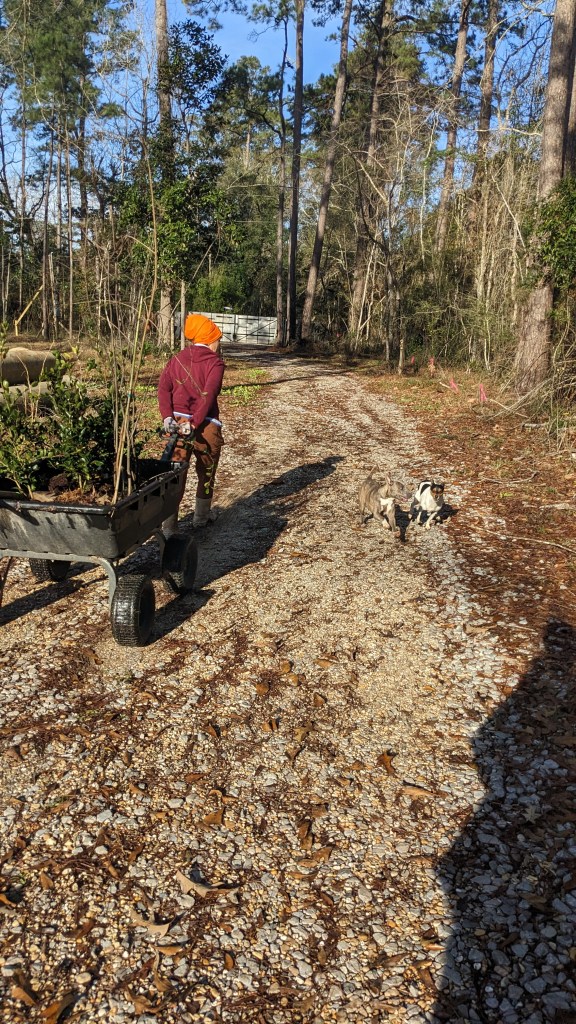
Hauling a load of happiness for planting around the apiary.
Those with land in agricultural production can apply to the CSP. Agreements are for five years, have no acreage minimum, and pay a minimum of $1500 annually depending on your program. Find the deets at www.nrcs.usda.gov.
Farming is changing. Some say too little, too late but from Big Ag to urban lots agricultural producers are discovering that using practices that conserve and improve the health of the land result in better production. These lessons are often learned the hard way.
The National Resource Conservation Service was one of the agencies created in response to the Dust Bowl–a tragedy born of drought and poor farm practices that led to the loss of topsoil in vast areas of the nation’s heartland. The tillage practices in common use during the 1930s that led to the Dust Bowl led to incredible crops–for a few years. Ultimately unsustainable, deep tillage led to the loss of arable land. Today soil is improved through no-till planting and the use of cover crops to control weeds, hold in water, and add nutrients. Not only do these methods improve soil and help sequester carbon, but they ultimately lead to better crops with less money spent on inputs like herbicides, pesticides, and fertilizer.
Native flag iris growing in the bayou that runs through Big Branch Apiary.
Our to-do list for today looks something like this: 1. Tend to birds–feed & collect eggs. 2. Check levels on the bee feeders. We added a pollen feed station over the weekend and will place pollen patties in each hive so the girls get all the protein and nutrients they need to grow in number. 3. Plant food-producing trees. We have Autumn Brilliance serviceberry–a variety that can grow in our USDA zone, Persian and dwarf mulberry, native persimmon, low chill-hour apples, and about 200 new and replacement varieties of blueberries to meet our Conservation Stewardship Program requirements. We will also plant Mrs. GG Gerbing azaleas, Snow on the Mountain sasanquas, a Montezuma cypress, three Torrey Pines, and a sweet olive because it’s hard to imagine having too many beautiful trees, and beauty, after all, helps feed the soul.
“Inflation is when you pay fifteen dollars for the ten-dollar haircut you used to get for five dollars when you had hair.” ~Sam Ewing
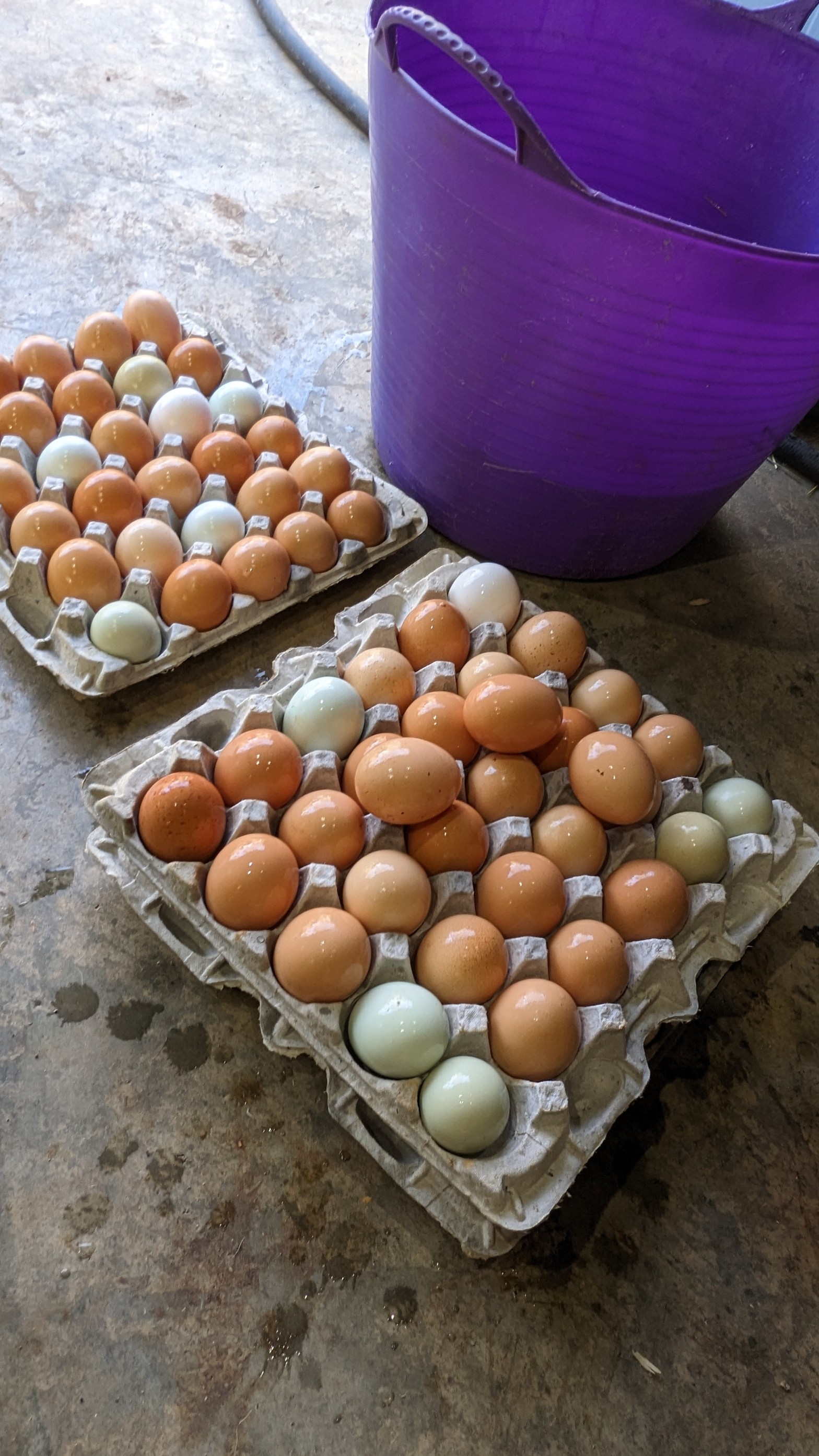
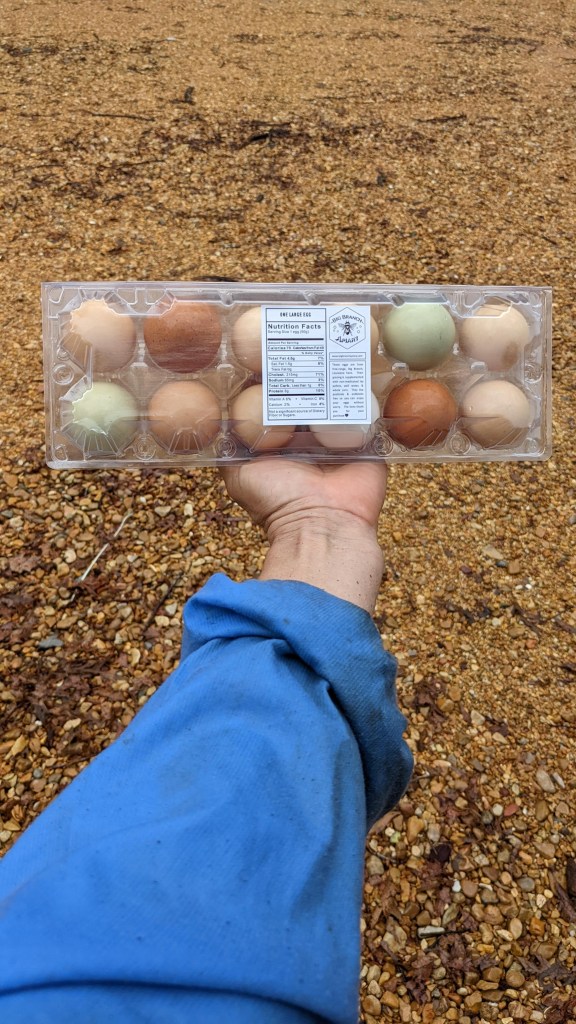
Although we initially intended to just raise bees, here at Big Branch Apiary we have four main products that bring in revenue. In order of least to most lucrative, they are: ◆Cut flowers ◆Blueberrries ◆Honey ◆Eggs
The current increase in eggs is driven by the H5N1 Bird Flue epidemic. According to the CDC it has infected over 57,800,000 in 47 states since January 2022.
With a flock that is half pet, half farm animal, eggs are supposed to be a novelty by-product here at the farm. You can read my January 4th blog for more on this quandary.
Four years ago we sold eggs mostly to neighbors. We asked $2 a dozen in order to break even.
Then we moved to the farm. We gained customers and the flock grew to accommodate the demand. Feed prices had climbed so the price of eggs was raised to $5 a dozen. Off-season we sold wholesale to Top Box and Recirculating Farms–two entities that distribute affordable produce to inner city areas of New Orleans. And we were able to make a meager profit.
Then came 2022 and a $900 loss. I’m giving you hard numbers in case you go to the grocery store, see the price of eggs, and think something foolish along the lines of, “I’mma get me some chickens and raise my own eggs!” That first egg will be the most expensive you ever stuffed in your mouth.
The first challenge was predation. Coyotes found the flock and in mid-day with me not 100 yards away, a coyote dashed out of the woods and grabbed a hen. Big Tom, bite-sized fool that he is, chased after them with no effect. A head count indicated this was not the first meal. But it was their last. We countered by shutting the flock into their pen and bringing the forage to them: we purchased cabbages, dumped the weeds from the garden to them, and gave them pumpkins left over from fall decorating. It kept them from being eaten but their consumption of commercial food tripled.
And then the price of that food took on extortion-like proportions. What we had paid $10 for two years ago was now over $17. In some cases, the price not only jumped but the bag went from 50 to 40 pounds. We countered by feeding deer corn which had also jumped in price, but not like the same corn packaged for farm animals. We purchased in bulk at Tractor Supply which gleaned a meager 5% off.
We sold off the always-hungry turkeys.
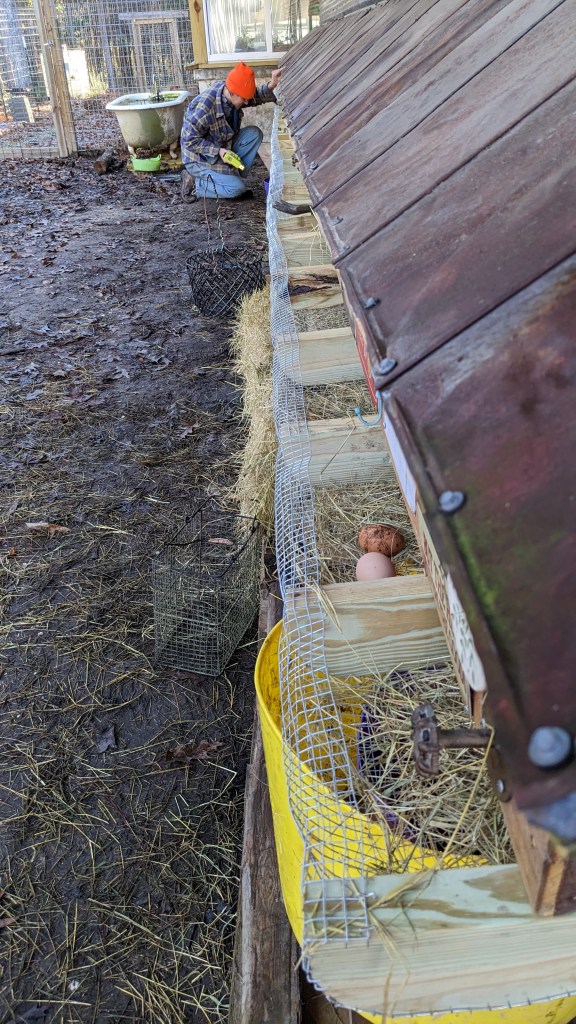
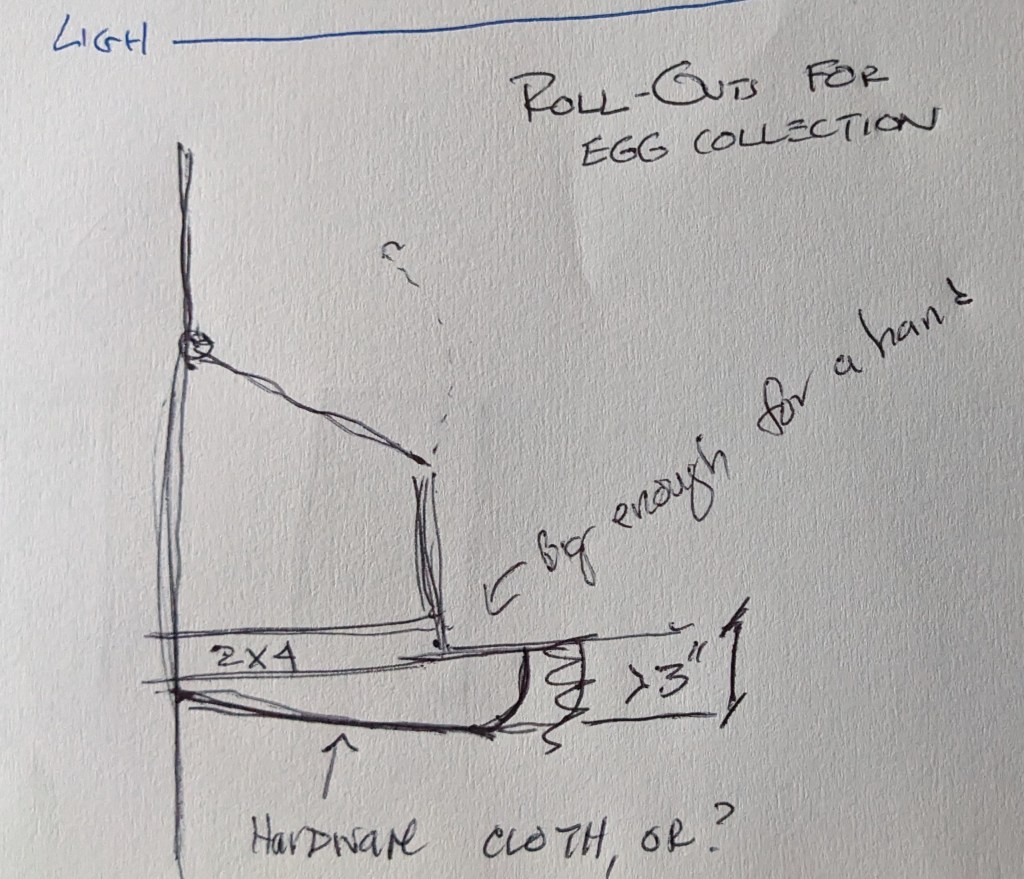
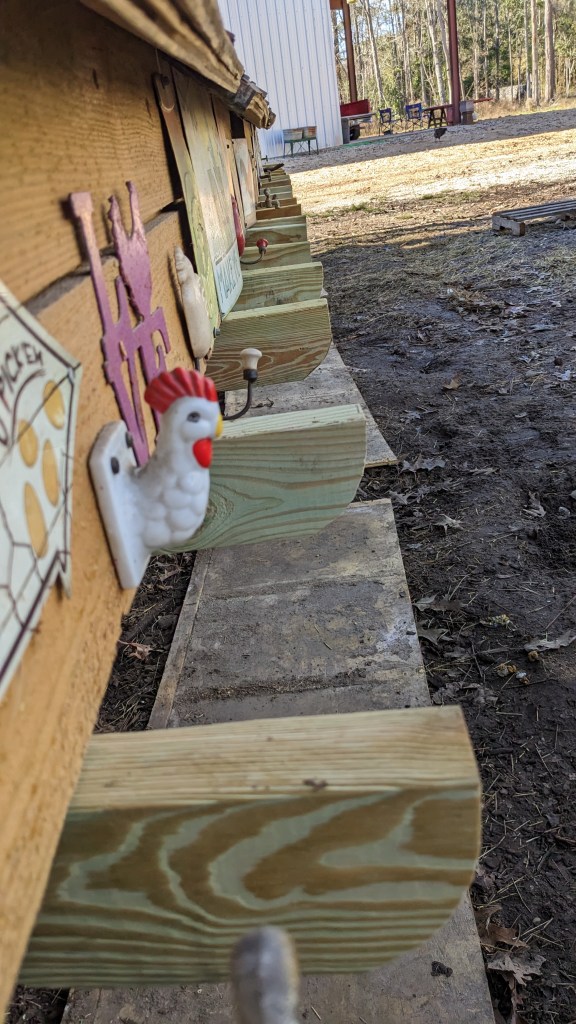
Other losses came in the way of fowl pox which decimated the replacement hen flock. We countered by starting a vaccination program. We weeded out chickens that decided to they, too, liked to eat eggs. Some landed in the freezer as food themselves. We also retrofitted the nest boxes with a roll-out feature so the birds couldn’t be tempted to eat their own eggs. This also had the benefit of keeping the hens from accidentally cracking eggs as they jostled with each other in the nest boxes.
Roll-out retrofit of the nest boxes put eggs out of harm’s way.
We are also going to try tractor pens–enclosed moveable runs that allow for unrestricted grazing while protecting the hens from predators.
And finally, sadly, we raised prices.
I recall a passage from the book “Angela’s Ashes” in which the gifted seanchaidhe, Frank McCort tells a story from his impoverished boyhood where he found and ate an egg. He described the experience so well that I still relish that egg with him today. But time will tell if we are able to keep eggs affordable or if eggs move from a pantry staple to an unaffordable and rare luxury like they were to young Frank McCort.
Today’s chore list was light and looked something like this: 1. Feed hens and bees 2. Put final touches on roll-out egg box 3. Plant garlic starts 4. Move 1-year-old asparagus to better light in hothouse
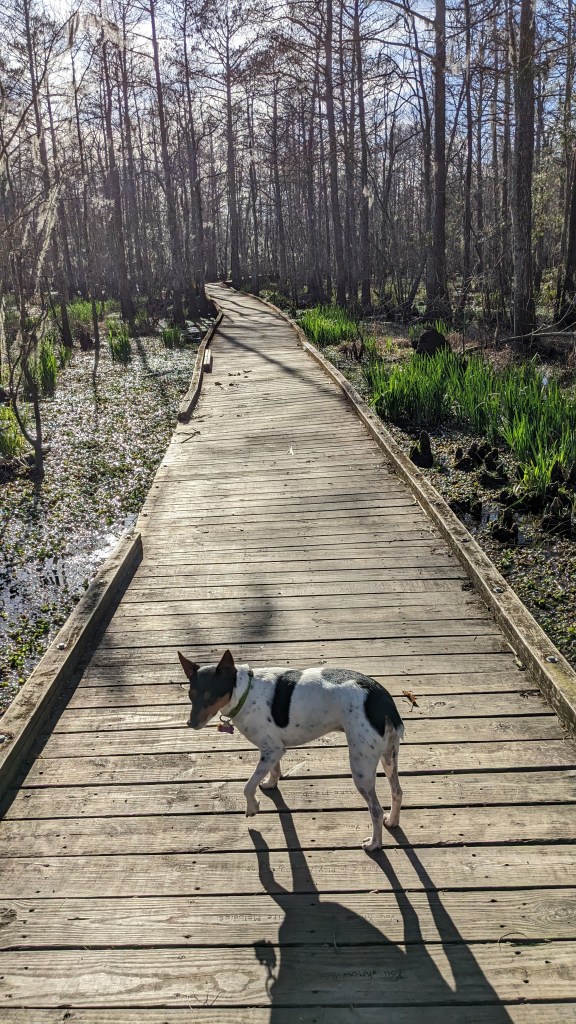
That was enough. It was a glorious day so we thought the rest was best spent on a hike. We loaded the dogs into the truck and headed out to Boy Scout Road and the tranquility of Big Branch Marsh.
Bayou Lacombe where it meanders through Big Branch Marsh Wildlife Sanctuary.












 Big Branch Apiary, LLC