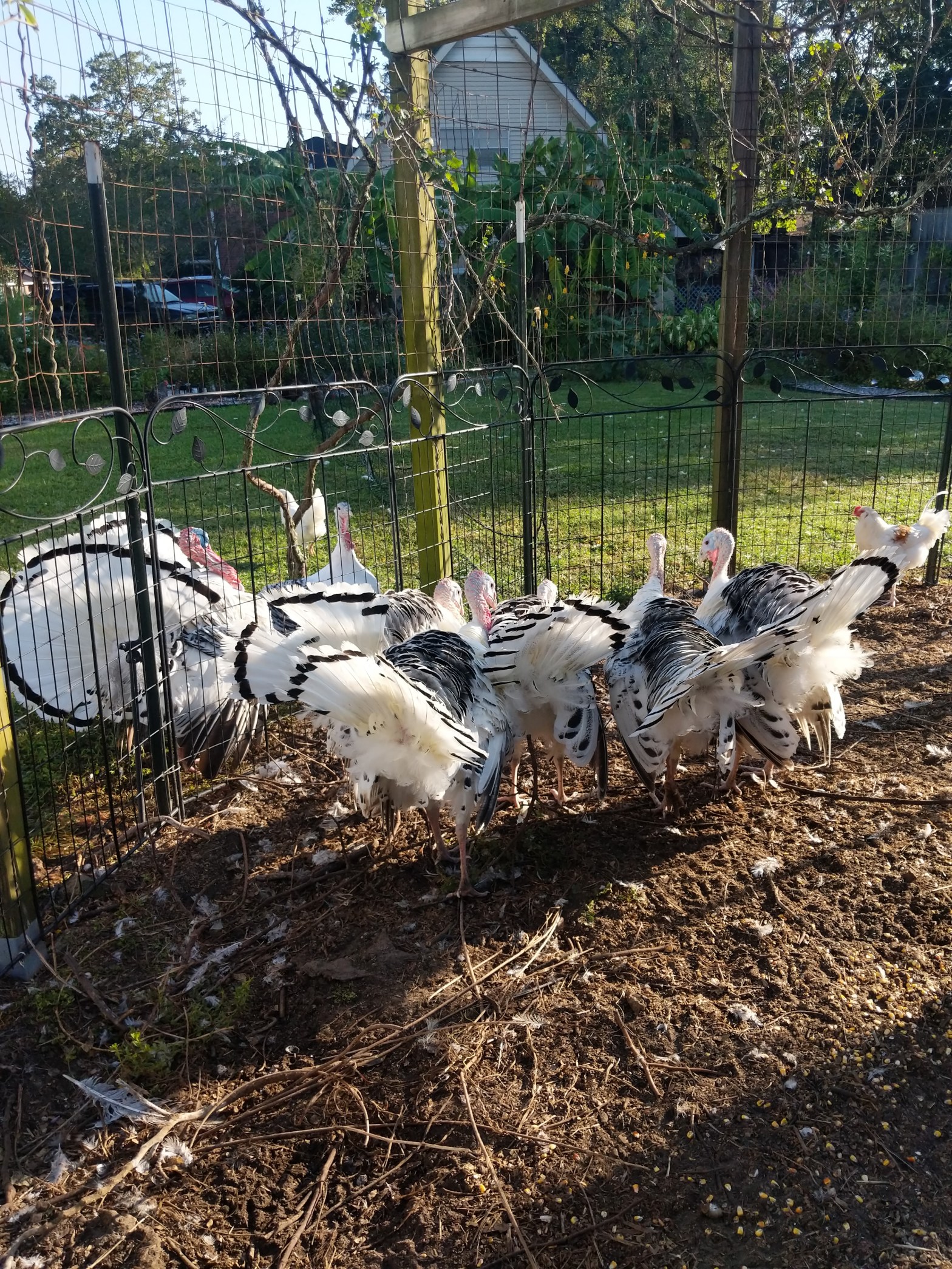
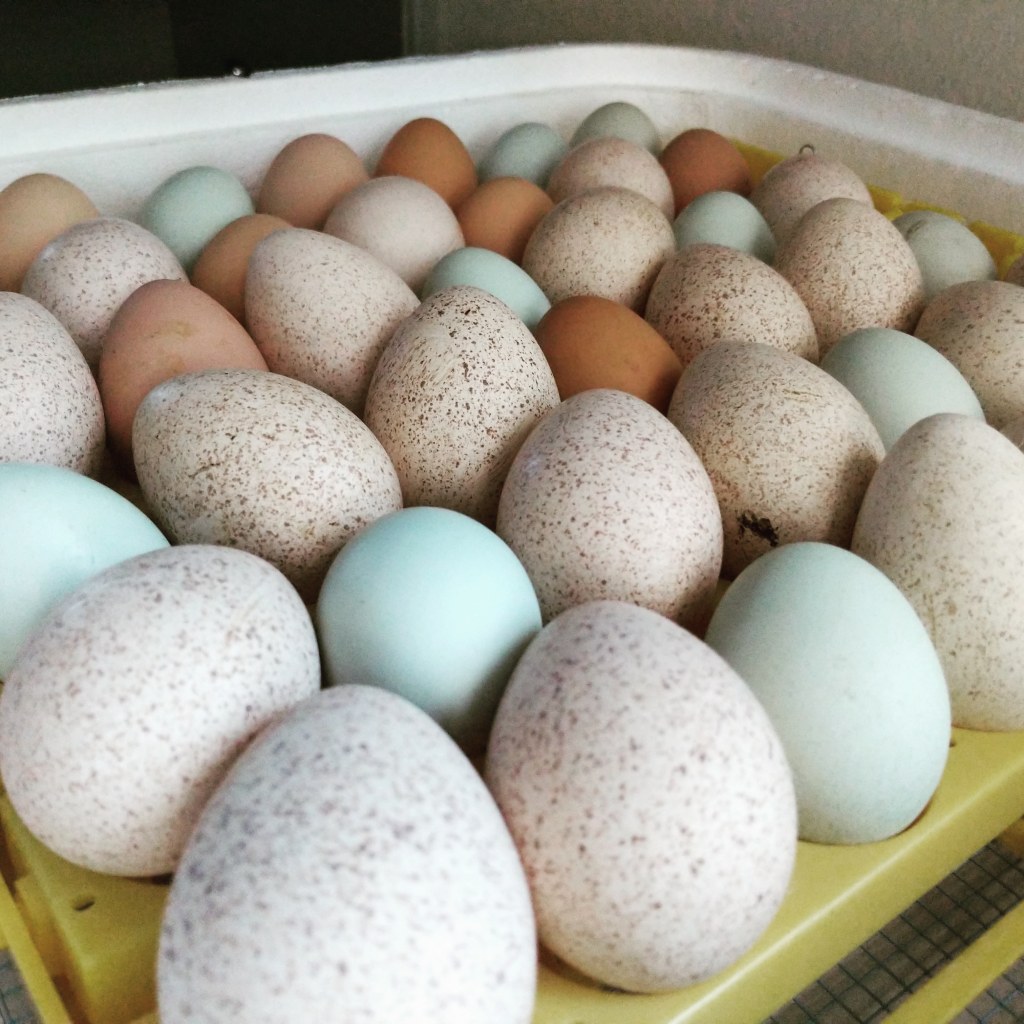
They may have been destined for Thanksgiving dinner, but then they found a home on Jacob King’s Donaldsonville farm. Jacob has a menagerie that includes goats, sheep, some pigs, chickens and even a pair of peacocks. He felt some Royal Palms would make an excellent addition.
Jacob King and his five new turkeys loaded u and ready to go home.
Small in stature but large in attitude, Royal Palms are a heritage breed–kept for their beauty and generally considered as too small to be commercially profitable on a large scale. They weigh in at 10 pounds for hens and up to 16 pounds for toms. According to the Livestock Conservancy, the Palm was first seen in Florida in the 1930’s. They were recognized as a distinct breed in 1971.
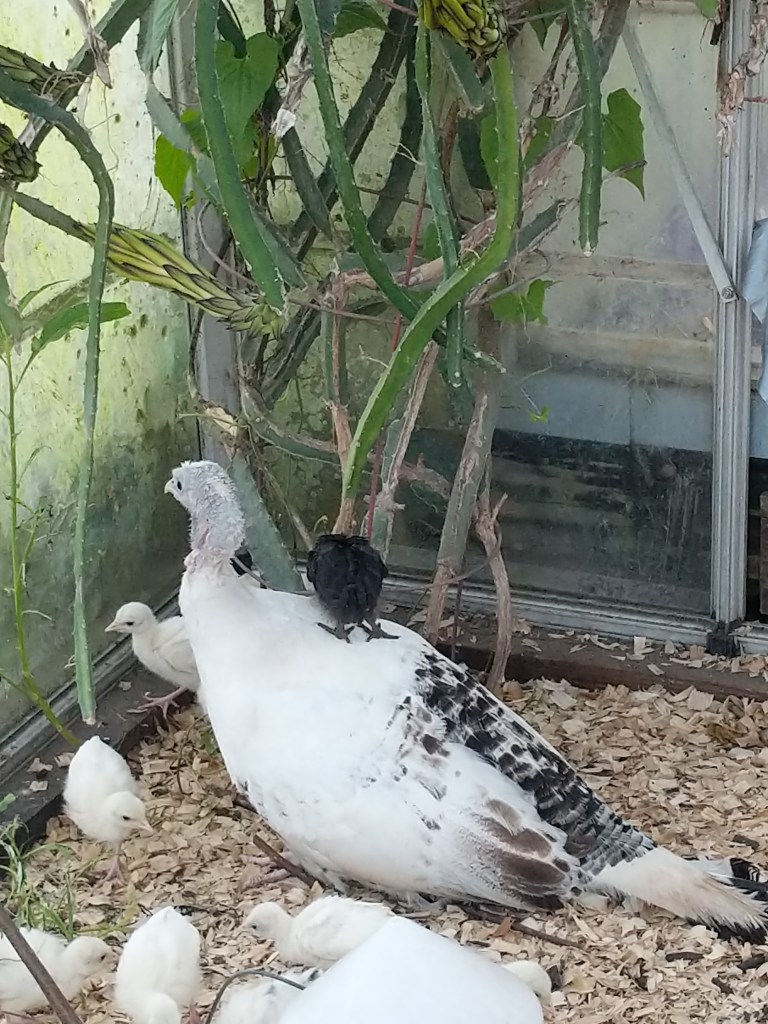
Out turkey hens proved to be great mothers. Here at Big Branch Apiary we let our girls raise the chicks we hatched along with the poults. If you are incubating keep in mind that turkeys hatch after 28 days and chickens after only 21. Make sure to coordinate the hatch if you want to raise them together.
Although the hens lay regularly, unlike many chickens they quit laying in the fall. We have to wait but still, we are excited for next spring and the new batch of chicks!
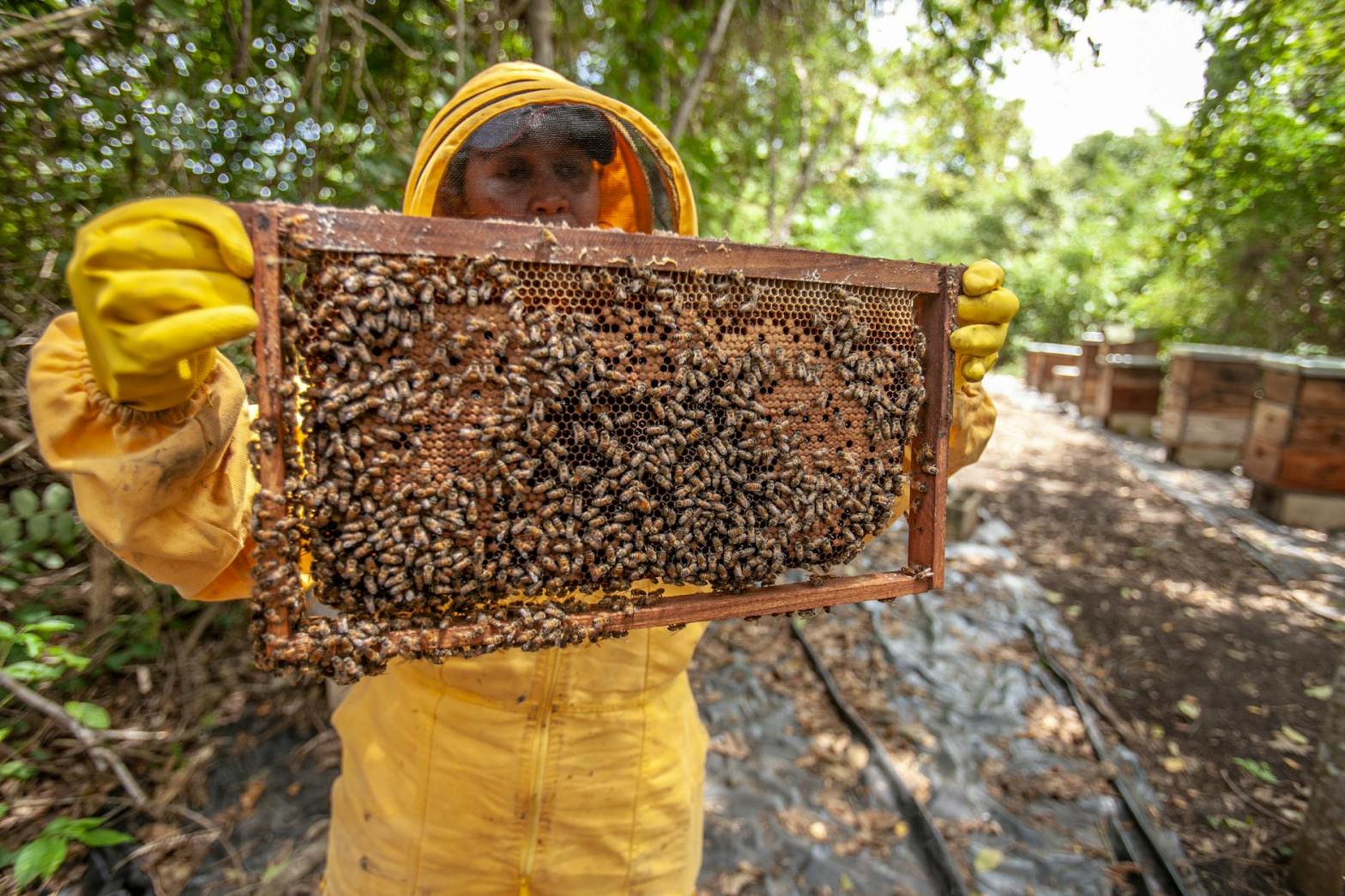
HONEY. It has begun: today we pulled honey from approximately half the hives. We sterilized jars tonight and will begin extracting/bottling tomorrow (6 June, 2024). Local, raw, unpasurturized honey will be available this Friday–FINALLY!
Honey Bou Cou!
PRICING. I must have hidden our pricing in some obscure corner of the website. My apologies–the number one question I get from people is what are your prices? So, here they are.
Honey goes for $10 a pint & $5 for a 6oz jar. We traditionally sell out by October. The spring pull is really nice, with a citrusy undertone and, dare I say, a hint of blueberry to it🫐
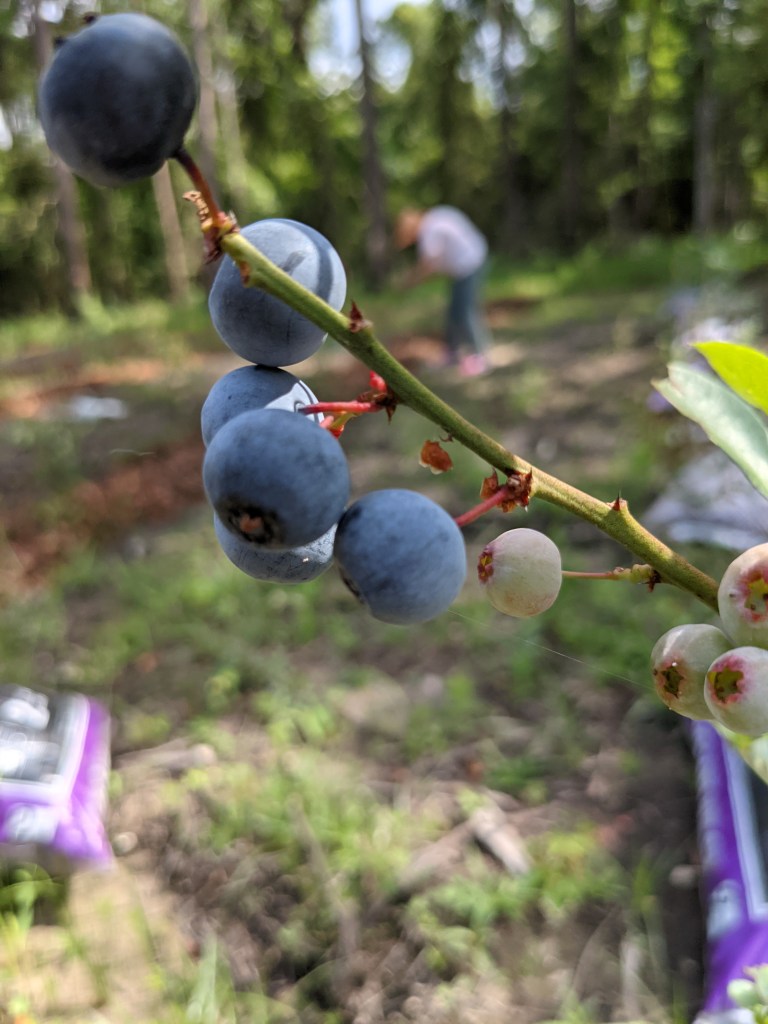
We sell bueberries for $5 a pint and $30 a gallon (which gets you two free pints). The harvest was really good this year, but it was three weeks early. We traditionally have blueberries into the third week of June, but with the early start we’re not sure what nature will punt our way. Right now it looks like we have at least two more weeks of berries on the bushes. Are you interested in reduced price or even free blueberries? Ask us about the paydirt program: you pick some for the farm to offset the price of your berries.
We also sell free range eggs for $6 a dozen. We have eggs year-round.
You don’t need a reservation or to call ahead. We’re open Tuesday through Sunday from 7 to 4. If you come early, you beat the heat, but you get an extra dose of deer flies. If you show up during the middle of the day, it’s hot as blazes, but the deer flies have gone into retreat. We treat for ants, but anybody who lives in the Southeast knows that fire ants are a fact of life. Wear shoes they can’t bite through. Bring bug spray and a hat. Can’t find the farmer hanging around the barn–then just grab a bucket and head up to the field to pick you some blueberries. We really appreciate the business and truly enjoyed meeting those of you who have come out to the farm.
We weren’t sure there would be a season after last year’s drought, but the bushes look great and are loaded with ripening blueberries. Due to the mild winter, Nature is ahead of schedule so we’ll be opening a week early this year, on Tuesday, May 28th. We’ll be open six days a week–Tuesday through Sunday from 7:00 AM to 4:00 PM–until the harvest is done (usually the third week of June).
Prices are the same: $5 a pint for berries, $10 a quart for honey, and $6 a dozen for our free-range eggs. You can pick flowers for a donation of your choice–proceeds go to pay for next year’s seeds.
We have a few additions to announce. Gloria arrived last fall. She is the friendliest mule ever and will beg to be scratched and fed. Bring carrots or apples if you want to feed her–they’re her favorites. We also have 5 sheep–they will mostly stare at you from afar and stomp their feet if you get too close. Sadly they had no lambs this spring but we’re hopeful for next year. A peacock decided to move in from who-knows-where. His name is Waldo and he’s a handsome boy. The final addition is a Jack Russel pup named Rue. She looks cute but she’s nothing more than a fast-moving conveyance method for a litany of very sharp teeth.
Chicks should start hatching in about four days (approximately May 9th). We see this every spring yet it still feels like magic to see a chick emerge from an egg.
We post seasonal updates regarding the harvest, honey availability, &c on social media. If interested you can subscribe to this (infrequent) newsletter below or check us out at https://www.facebook.com/BigBranchApiary, http://www.ben-iesau.com, Instagram @Big_Branch_Apiary, or text us at 985-422-0880.
For those of you who have dropped off your glass bottles for recycling, yea, we are still making them. We’ll take any glass bottle, especially wine bottles, preferably with lids or caps.
Any of you living in the Gulf South know that we’ve had an early spring with (mostly) beautiful weather and warm temps. As a result, nature is in a full sprint and this farmer is working hard to keep up.
It could be my imagination, but everything seems to be a few weeks early. We’re already seeing fireflies– something my recollection tells me usually arrives late April. The blueberries are hung with blooms and already loaded with tiny fruit. Also, the bees are coming out of winter in great shape with very little winter die-off. We’ve been splitting the hives and it looks like there’s potential for a decent harvest of honey as well.
If the weather holds we may be harvesting honey by the end of May, and opening for blueberry season a week early–the last week of May instead of the first week of June. But ultimately Nature will decide and we will set our schedule accordingly.
This year the u-pic will open five days a week, Wednesday through Sunday, to let the berries (and the farmer) rest. Hours remain 7-4.
Hope to see you out here!
The pollinators are enjoying the blueberry blossoms and are doing their part for the harvest.
Happy Earth Day. Did you know that Earth Day was first celebrated in 1970? And it is now celebrated in almost 200 countries Earth-wide.
In the US we celebrate it on April 22nd (a day chosen to appeal to college students, apparently) but in many countries, it is celebrated on the Spring Equinox.
It was started by the efforts of Wisconsin Senator Gaylord Nelson (back when Senators were public servants and not pawns paid for by corporate interests (shut UP, Cheri’!)) and other environmentalists.
Earth Day has led to a litany of conservation-minded legislation but the first attempts to promote environmental conservation by JFK were met with paltry enthusiasm by the media.
Every year since 2016 there has been a central theme for the celebration. This year’s theme is “Invest in our planet.” But really, no matter how you celebrate you are helping. Remember: there is currently no Plan(et) B.
Here’s a forwarded list of Earth-friendly local (Louisiana) events and resources for you to utilize. You can sign up for their newsletter to stay abreast of all things healthy-in-NOLA. 🌳 Happy Earth Day From RecircFarms!🌍 (mailchi.mp)
And if you want to help a local, Earth-loving bee farm in its quest to stay organic you can contact Big Branch Apiary for volunteer opportunities!
This is Love the Boot Week here in Louisiana and people are engaged in beautification and cleanup projects statewide. Big Branch Apiary got to do our part and helped out at the Rivertown Butterfly Garden. We donated about 40 perennial flowers and spent the day weeding, planting, and mulching alongside like-minded volunteers.
The LSU AG center was on hand as were six Master Gardeners, the Mayor of Kenner, several council members, and a host of community and city volunteers.
The butterfly garden was one of the initiatives of the Rivertown Arts Council which I was a member of. Momentum slowed, people moved, and the garden was nearly lost until Barbara Seiede decided to take it on in earnest. Thanks to her hard work it is now a lovely, thriving garden spot that will be loved by people and pollinators alike.
Me and Barbara Suede. Barbara, an artist and avid gardener, walked into my yard one day and introduced herself. That was a serendipitous meeting. Barbara has been the force behind the recent renovations to the garden.
Your’s truly and LSU Extension Agent Christ Dunaway are ready to plant some native hibiscus in the Rivertown butterfly garden.
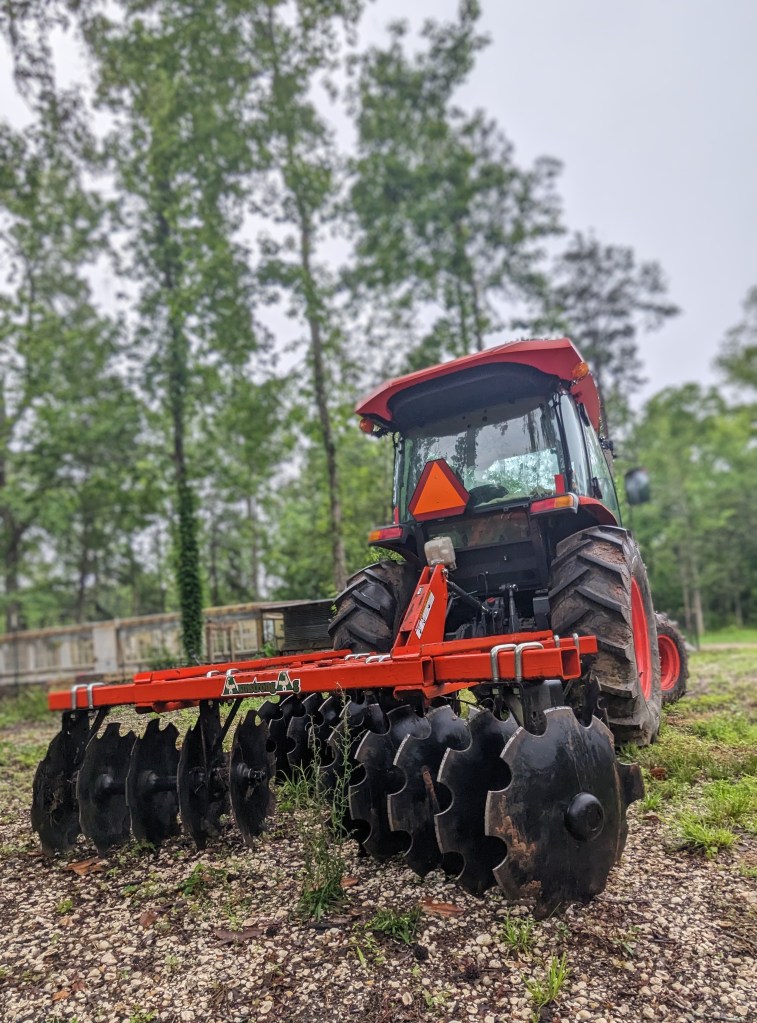
Yesterday I put the disc on the tractor to work a patch of ground in preparation to plant a small apple orchard. I’ve been preparing this spot for a year. First there was seeding with clover to break up the clay and add nitrogen. Then I mulched the entire area with cardboard, added 13 yards of topsoil, and added the chipped up wood from yaupon, small pines, and oak saplings . I piled on many, many bags of leaf litter which were donated by a neighbor who does landscape maintenance for the town of Mandeville. This recipe of biomass fermented, like a good wine, or sourdough, until it was time to disc it into the clay to make it ready for the young apples.
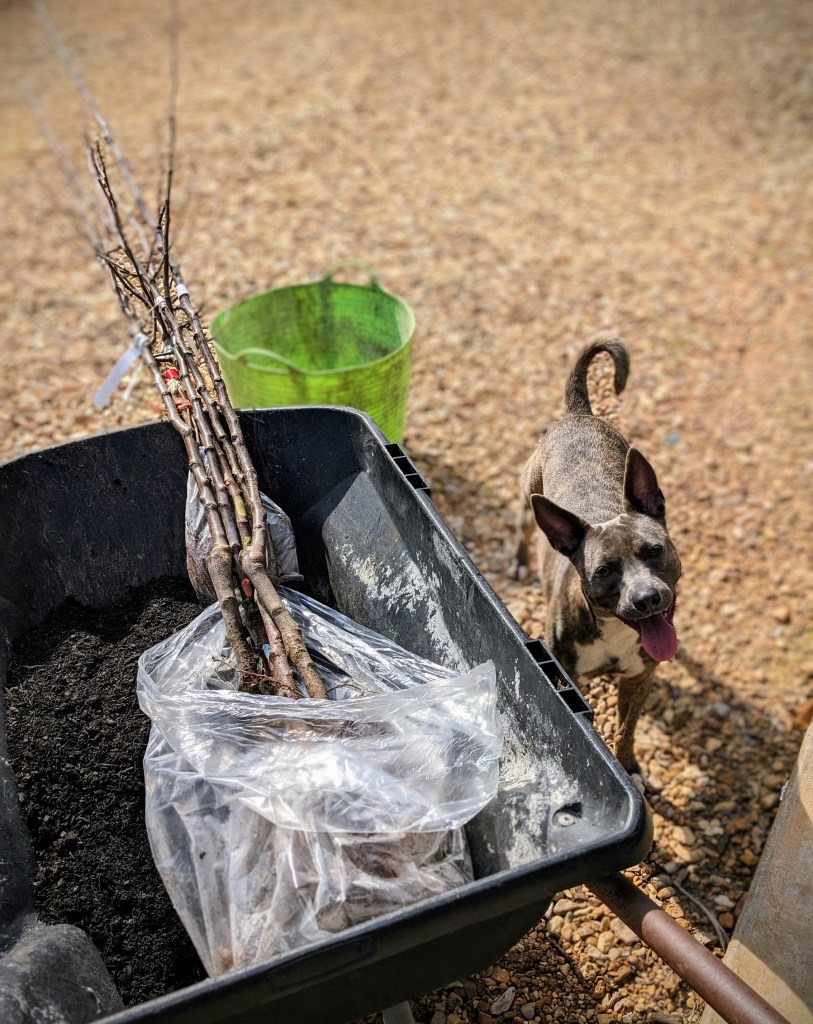
Newly unpacked apple saplings.
The smell of freshly turned soil is one of natures gifts. I had to occasionally stop to rescue fat toads as they tried to hop out of the tractor’s way, or remove large chunks of wood and dog toys. I discovered that this small field is where my pirate dog hides her treasure. Each time I stepped out I was met with the earthy, mineral smell of healthy soil.
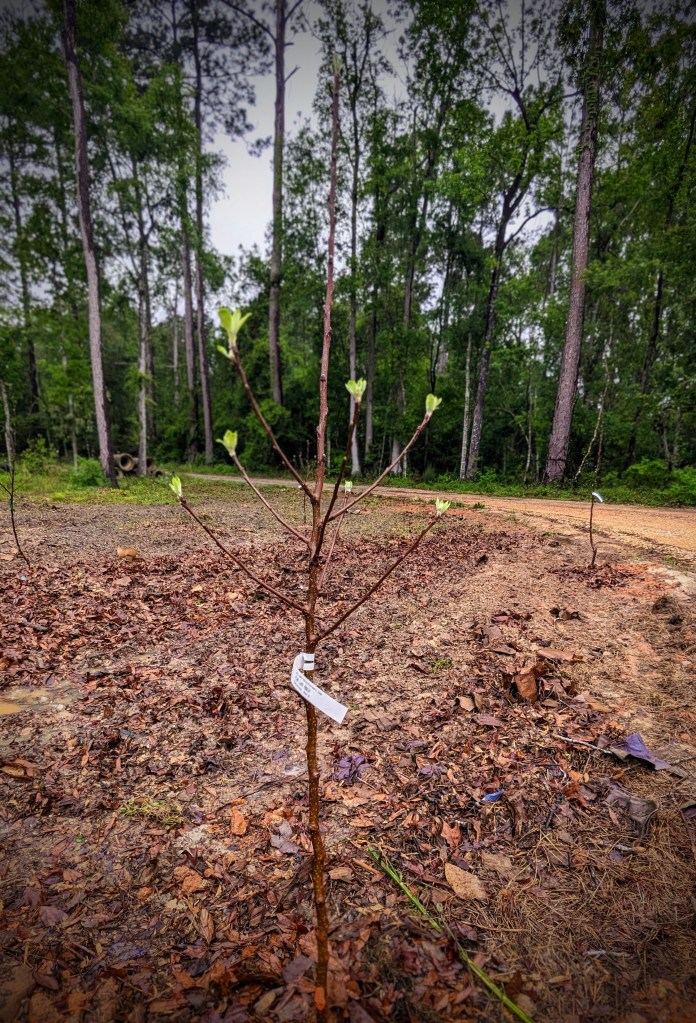
Newly planted apple varieties picked for a southern climate.
I purchased these trees from Mehrabyan Nursery. Their nursery is a sweet spot where price, quality, and selection meet. The owner is happy to answer your questions and their website is full of how-to resources.
Trees feed us, supply building material, offer shelter and shade, and their beauty is food for the soul. There is so much meditation in a new orchard, so much promise in trees that can outlive us before they are returned to the earth. I recently came across a beautiful eulogy trees that appeared in the April edition of “American Fruit Grower” magazine. It was a timely and appropriate rumination for planting new trees. The eulogy was written by Claire Kauffman, a pear and apple farmer in Pennsylvania. It captures some of wonder of the tree and the land that nurtures them. The eulogy follows but the full story by Thomas Skernivits can be found here.
Eulogy for the Apple Trees
Hear a eulogy for the trees. The legacy of these trees holds whispers of another way.
The way of generosity, in its purest, most selfless form. Without attachment or negotiation. Giving the best of gifts in spite of less-than-ideal circumstance.
The way of joy-filled being. Not holding on to the inner stories of grievance or complaint or even of wild success. Not chasing the numerous illusions and bobbleheads of the ego — just delighting in being an apple tree, and pouring joy into the great work.
The way of quietness and gentleness, of acceptance for what is. Offering a non-anxious, non-judging presence. A walk in the orchard is always an invitation into the present moment, to be right here, right now.
“If these trees could talk,” we say. Yet they do. Their storied lives ask us to pay attention to the earth, to our own stories, and to where our stories meet — in the air we breathe and in the ground beneath our feet.
They ask just to give attention to the past and to the future. Before this work of art, an orchard. A hundred years ago before the orchard, a dairy farm and tobacco land. Before that, our memory fades to the imagination of a forested ridge tended by its first peoples. This spring, at the time this work of art was being made, my son found an arrowhead protruding from a bit of open ground not 100 yards from here. A quiet yet persistent witness to a time when this land offered abundant food of kinds we now either despise or forget and was home to people to whom we’ve done the same.
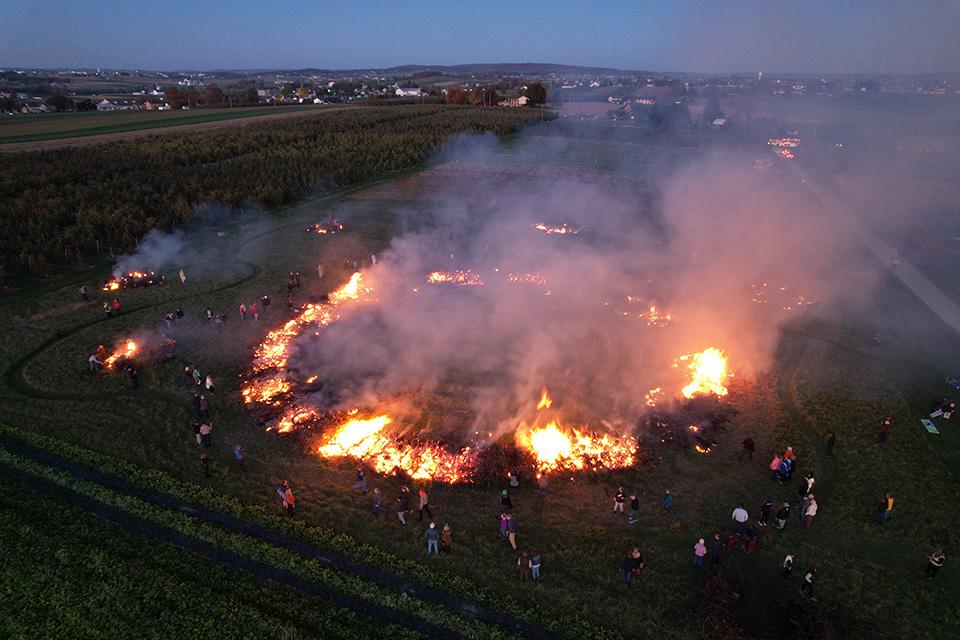
Photo courtesy of Kauffman Orchards
The stories quietly held by the land and the trees tell of life, and also death. Of freedom and wildness, and also of captivity and domestication. Of joy and flourishing, and also of grief and brokenness. It’s our story too, this paradox in the land and trees.
And what stories will be told 100 years from now? And how will the stories of the land and the trees be ours also? Will we have learned to live at peace with ourselves and with the land and what it requires of us? Or will we have been so slow to learn that this land finally becomes a mere witness to the manifest failures of industrial farming?
If these trees have a dying wish, I think it is this. Stay and listen. Wait a while. Give full attention inward and outward. Learn their way. Never forget their life, their joy, their stories, their legacy. Until patience has her perfect way with you and yields in you the fruit of wisdom.
This article on alternatives to glyphosate-based weed killers was recently shared with me and is a timely follow-up to my recent post on organic weed control. I thought it may be of interest to some of you. Particularly helpful to me were the pros-and-cons given for the different methods.
A week in and showing promise of turning into a good ferment.
For me, gardening often inspires me to try new ways to prepare and store the excess of nature. Right now, if you stayed on schedule and listened to Dan Gill and the LSU Ag Center, you likely have cabbage, broccoli, kale and their cruciferous cousins in your garden. And one of my favorite things to do with cabbage is to make sauerkraut.
I had several failures when I first tried to make sauerkraut. My piles of pounded cabbage turned into putrefied mush instead of fermenting into tart crispness. Disappointed but determined, I treid several more times. Finally, I added the fermentation liquid from a friend’s successful batch to my prepared cabbage and within a few weeks I had my first edible batch of homemade sauerkraut.
There are a lot of readily available recipes on the internet from people who are much more expert than me, but here is a link to a recipe that is similar to how I make my sauerkraut. I have a couple of personal recipe tweaks I like to make. I like my sauerkraut pink. I refer to it as Lilly Pulitzer sauerkraut because the pink and green reminds me of her signature colors. The pink tint comes from adding a thinly sliced, very small beet to about four heads of prepared cabbage. I also go easy on the salt–you can add more but trying to remove it if you get it too briny, well, if you figure out how to do that write it up and we’ll post it here.
All jarred up and stored in the fridge, but disappearing fast.
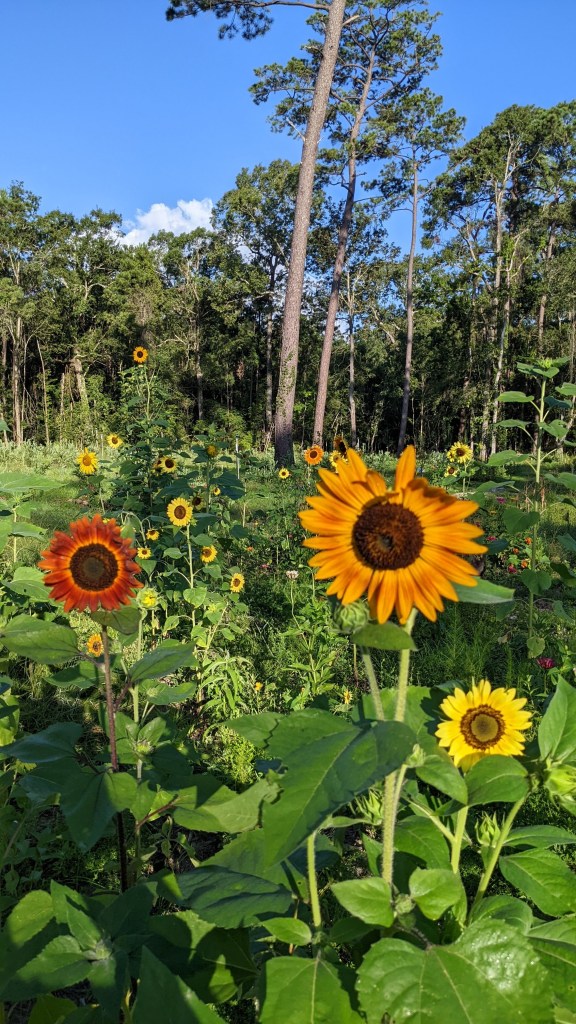
Other than making sauerkraut, this time of year still has us weeding and mulching at a fevered pitch. At least I have an explanation for the constant dirt under my fingernails. We recently added 200 more blueberry bushes, all early varieties. We have also been planting flowers – – gladiolus, ranunculus , sunflowers, and zinnias. We want the farm sporting a riot of blooms by the time U-Pick season starts.
And U-Pick season is just around the corner, only about 60 days away if Nature cooperates. We plan on being open June 1st until the berries are done producing which, last year, was 4th of July.











 Big Branch Apiary, LLC